

84% of small businesses using AI report a massive boost in productivity, yet most owners still spend their days "firefighting" 😰. If you feel like your business would collapse if you took a single day off, you are likely missing a modern operations plan for small business. The old way of manual documentation is slow and exhausting. The smart way uses AI to build a repeatable, automated engine that works even when you don't. Why spend weeks stressing over systems when you can have a professional strategy in minutes?
We know how stressful it is to maintain quality when you're doing everything yourself. This guide will show you how to transform your goals into a professional playbook that saves time and keeps your team on track. We'll preview the 2026 AI "stack" and show you how to align with upcoming ISO 9001:2026 standards to stay competitive. You're about to turn your business into a scalable system that is ready for partners and investors ✨.
Key Takeaways
- Transform your business from a "messy reality" into a repeatable engine by translating high-level strategy into daily, automated actions.
- Build a scalable operations plan for small business by focusing on the five essential pillars, including customer journey mapping and role-based org structures.
- Stop wasting 40+ hours on manual writing and switch to the "Smart Way" using AI to generate a professional 72-section plan in minutes ✨.
- Establish clear, measurable operational KPIs that allow your team to maintain quality and consistency even when you take a day off.
- Learn how to use your operational playbook to attract investors or secure funding by proving your business is a stable, automated machine.
What is an Operations Plan for Small Business?
An operations plan for small business is your company’s practical playbook. It translates high level strategy into daily, repeatable actions that your team can follow without your constant supervision. Think of your business like a vehicle. Your strategy is the destination and the GPS; your operations plan is the mechanical engine under the hood. Without a functional engine, you aren't going anywhere, no matter how good the destination looks on paper. This document is the essential bridge between "what we do" and "how we do it" at scale.
When you build a clear operational framework, you unlock three major benefits: consistency, scalability, and reduced founder burnout. Consistency ensures your customers get the same high quality service every single time. Scalability means you can handle ten times the volume without ten times the stress. Most importantly, it stops the daily "firefighting" that leaves entrepreneurs exhausted. You're building a system that works so you don't have to ✨.
Strategic vs. Operational Planning: Knowing the Difference
Many small business owners confuse strategy with operations, which leads to "analysis paralysis." Strategic plans focus on the big picture of where you are going over the next three to five years. In contrast, Operational planning focuses on the "how" of your daily tasks. It details who is responsible for what and which tools they use to get it done. Aligning your daily workflows with your 2026 revenue goals ensures that every hour spent in the office actually moves the needle toward your long term vision.
Why Small Businesses Fail Without a Clear Playbook
The "Founder Trap" is the most common reason growth stalls 😰. This happens when the business is entirely dependent on the owner's personal knowledge and energy. If the business stops when you take a day off, you don't own a business; you own a high pressure job. Without documented Standard Operating Procedures (SOPs), your team is forced to guess, leading to expensive human errors and inconsistent service that drives customers away.
The data on this is clear. According to the Bureau of Labor Statistics, approximately 20% of small businesses fail within their first year, and 50% fail by the end of their fifth year. A primary driver of these failures is the inability to scale operations efficiently. Companies that prioritize documented systems are not only more likely to survive, but they are also much easier to sell or exit later. Investors don't buy "busy" founders; they buy repeatable engines that generate profit without friction.
The 5 Essential Pillars of Your Operational Framework
Building a scalable operations plan for small business requires more than just a list of to-do items. You need a structured framework that supports growth without collapsing under its own weight. Think of these five pillars as the load-bearing walls of your company. If one is weak, the entire structure is at risk. By defining these areas clearly, you move from "guessing" to "knowing" exactly how your business functions every day.
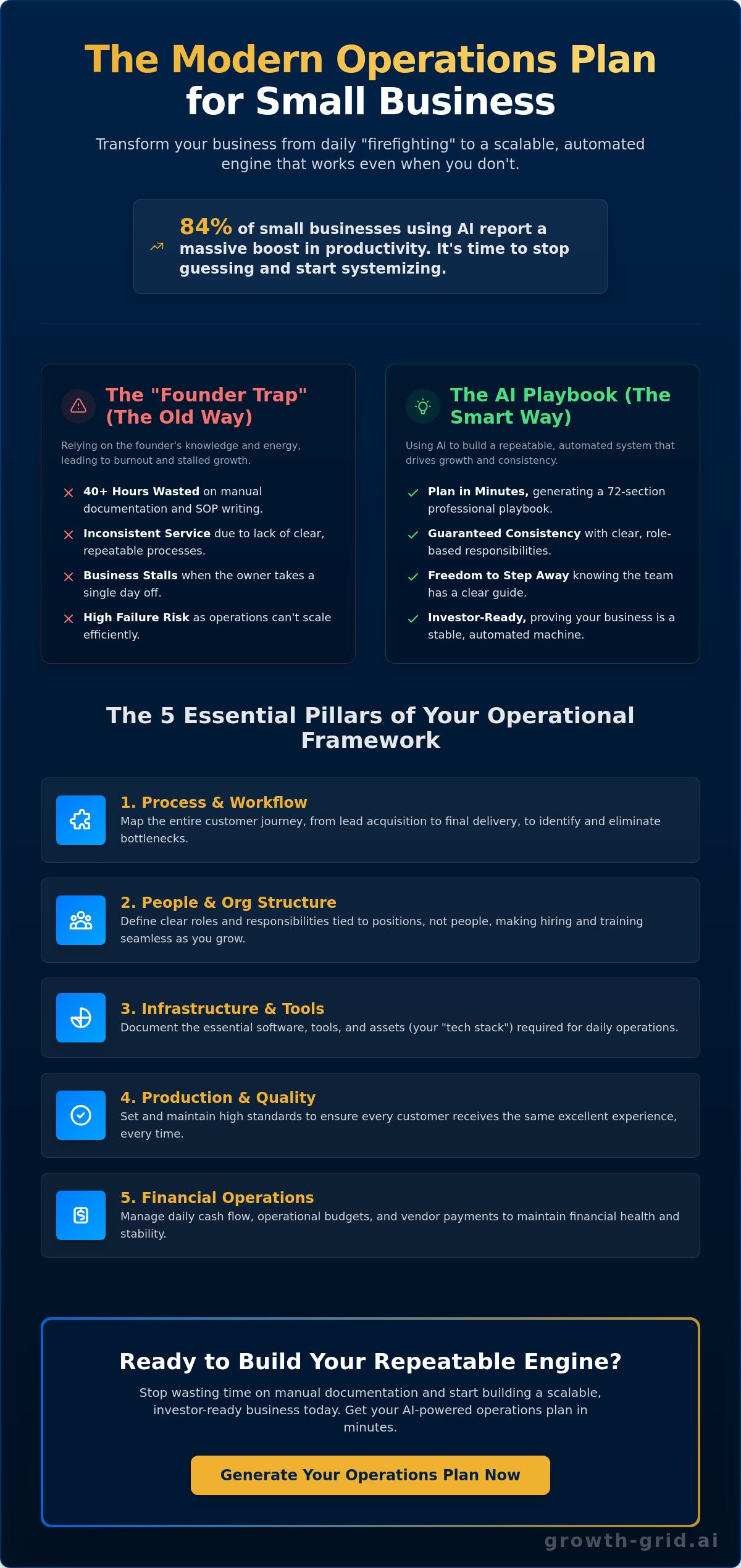
- Pillar 1: Process and Workflow. This involves mapping the entire customer journey. You must track every touchpoint from the moment a lead enters your system to the final delivery of your service.
- Pillar 2: People and Org Structure. You need to define roles, not just names. This ensures that responsibilities are tied to positions, making it easier to hire and train new team members as you expand.
- Pillar 3: Infrastructure. These are the tools, software, and physical assets required to operate. In a modern environment, this often includes your digital "stack" and remote-work capabilities.
- Pillar 4: Production and Quality. This pillar defines your standards. It ensures that the tenth customer receives the exact same high-quality experience as the first one.
- Pillar 5: Financial Operations. This covers the "money in, money out" of daily life. It includes managing cash flow, operational budgets, and vendor payments to keep the lights on.
Mapping Your Core Business Processes
Efficiency starts with identifying your "Critical Path." These are the 20% of activities that drive 80% of your business value. By visualizing these workflows, you can identify bottlenecks before they cause a crisis 😰. For example, if your onboarding process takes too long, it will eventually choke your sales growth. Many founders use specialized business plan software to document these flows, ensuring they remain accessible and easy to update as the business evolves.
Digital Infrastructure for the 2026 Workplace
Your tech stack is the backbone of your operational plan. In 2026, small businesses must choose between centralized and decentralized tools based on their team's needs. A centralized system keeps everything in one place, while decentralized tools allow for more flexibility in remote-first environments. According to the SBA guide to business planning, documenting these requirements is vital for long-term stability. You also need to integrate privacy policies and NDAs directly into your operations to secure your data. If you're ready to stop stressing over the details, you can generate a professional operations strategy that handles the heavy lifting for you ✨.
Step-by-Step: How to Write Your Operations Plan
Creating an operations plan for small business doesn't have to be a month-long headache. You can build a professional framework by following a logical, five-step process that moves from chaos to clarity. Most owners fail because they try to document everything at once. Instead, start by auditing your current "messy" reality. Look for the tasks that cause the most stress or lead to the most frequent errors 😰. Once you identify these friction points, you can build systems that actually solve problems rather than just filling a binder with useless paperwork.
- Step 1: Audit Your Reality. List every task performed in a typical week. Identify which ones are repeatable and which ones require your personal "magic touch."
- Step 2: Define Operational KPIs. Set measurable targets for each department. This could be a 98% order accuracy rate or a 2-hour lead response time.
- Step 3: Draft Standard Operating Procedures (SOPs). Focus on high-frequency tasks first. Write simple, clear instructions that a new hire could follow with zero training.
- Step 4: Allocate Resources. Determine the budget, tools, and headcount needed to hit your KPIs. Don't guess; use data to justify every dollar.
- Step 5: Review and Iterate. Your plan is a living document. Schedule a quarterly review to update your processes as your business grows and tech evolves ✨.
Setting Realistic Operational Milestones
You need to move from vague goals to concrete operational targets. For example, instead of aiming to "improve shipping," set a milestone for a 24-hour turnaround on all orders. This gives your team a clear finish line to cross every day. You can track this progress through automated dashboards, which allows you to monitor health without micromanaging your staff. Operational milestones act as the pulse of a healthy small business, letting you know exactly when your systems are under strain. Understanding the importance of strategic planning ensures these milestones align with your 2026 revenue targets.
Budgeting for Operational Success
Smart founders distinguish between "Growth Spend" and "Operational Maintenance." While growth spend buys you new customers, maintenance ensures you don't lose the ones you already have. To fund your daily operations effectively, you should conduct a regular cash flow analysis. This helps you identify exactly how much capital is required to keep the engine running smoothly. It also allows you to plan for unexpected operational shocks, such as sudden tech failures or supply chain disruptions. By preparing for these "what-if" scenarios, you protect your profit margins from being erased by avoidable crises.
Traditional Planning vs. AI-Powered Efficiency
For years, the traditional way of building an operations plan for small business was a grueling marathon. You'd spend 40+ hours staring at a blinking cursor or pay a consultant $2,000+ to do it for you. These manual plans are often "dead on arrival." They sit in a drawer gathering dust because they're too difficult to update as your business evolves. Why spend weeks stressing when you can have it done in minutes? 😰
The contrast is clear when you look at the Old Way vs. the Smart Way:
- The Old Way: ✗ 40+ hours of manual writing. ✗ Expensive consultants ($2,000+). ✗ Static, outdated templates.
- The Smart Way: ✓ 72-section plan in under 15 minutes. ✓ Professional quality for just $19. ✓ Dynamic updates ✨.
Choosing the smart way doesn't just save money; it saves your sanity. You can generate your personalised business plan right now and skip the weeks of frustration. It is a smarter, faster approach that puts you back in control of your time.
The Hidden Costs of DIY Operations Planning
Calculating the "Opportunity Cost" of your time is essential for any savvy owner. If you spend two weeks writing a plan, that is time taken away from sales, product development, and customer service. Beyond the time sink, there is a high risk of missing critical legal or financial sections in a manual draft. A missing clause in an HR document or a vague process in a production workflow can lead to expensive human errors later. GrowthGrid eliminates the "blank page syndrome" instantly. It ensures your AI business plan meets modern standards without the heavy lifting.
How AI Generates Professional Plans in Minutes
The input process is fast and intuitive. You simply answer targeted questions about your business model and goals. Our GPT-4 models then ensure industry-specific operational standards are met, providing a level of detail that manual templates often miss. The system can even generate supporting documents, such as NDAs and HR contracts, alongside your core operations plan. This is a smart, modern solution to an old, frustrating problem that empowers you to focus on growth instead of paperwork. We offer real support when you need it, ensuring you aren't alone in the process.
Implementation: From Document to Daily Action
A professional operations plan for small business is only valuable if your team actually uses it. Many founders make the mistake of treating their plan as a static file that sits in a cloud folder gathering digital dust. To avoid this, you must "onboard" your team to these new standards immediately. Introduce the document as the single source of truth for every workflow. When everyone follows the same playbook, you eliminate the confusion and "firefighting" that stalls growth 😰. This clarity allows you to stop micromanaging and start leading.
Investors and high level partners look for operational maturity before they write a check. They don't just bet on your product; they bet on your ability to deliver it consistently. A documented system proves that your business is a repeatable engine rather than a series of lucky breaks. You can also use your plan to automate the boring stuff. By linking your operational steps to project management tools like Asana or Trello, you turn your written strategy into a living dashboard of tasks and deadlines.
Every successful startup business plan must include a feedback loop. Your operations aren't set in stone. Encourage your team to suggest optimizations when they find a faster way to achieve a KPI. This creates a culture of continuous improvement that keeps your business lean and competitive ✨.
Scaling Your Operations as Revenue Grows
As your revenue increases, your team structure must evolve. You'll eventually need to move from "Generalist" roles, where everyone does a bit of everything, to "Specialist" operational leads. Having a clear operations plan for small business allows you to train these new hires 90% faster. Instead of weeks of shadowing, they have a professional document that explains exactly how to succeed in their role from day one. AI also plays a role here by conducting ongoing operational audits to find new efficiencies as you scale.
Integrating Your Ops Plan with GrowthGrid
The smart way to manage growth is to move beyond just a plan. With GrowthGrid, you can generate HR and Legal documents automatically to support your operational needs. Whether you need a new employment contract or a non disclosure agreement, our AI stack handles the paperwork in seconds. This ensures your business stays protected as it pivots or expands into new markets. Don't let manual documentation hold you back any longer. You can generate your professional operations plan in 8 minutes ✨ and start building the automated engine your business deserves.
Build Your Scalable Business Engine Today
You now have the roadmap to move from daily "firefighting" to a professional, automated system. By focusing on the five essential pillars and setting clear operational milestones, you can finally step away from the manual grind 😰. A solid operations plan for small business isn't just paperwork; it's the mechanical heart of your company that ensures quality remains high while you focus on high-level growth. It's time to stop guessing and start building with confidence.
GrowthGrid is the smart, modern solution for owners who value their time and sanity. We're already trusted by 10,000+ entrepreneurs to deliver comprehensive 72-section plans that are ready for partners or investors. Why spend weeks stressing over a blank page when you can have a professional strategy in minutes? We offer a 100% money-back guarantee to ensure you love your plan or get your money back. There's no risk, only the freedom of a business that runs itself ✨.
Generate your tailored operations plan in 8 minutes ✨
Your future as a scalable business owner starts right now. Take the first step toward a more efficient, profitable, and stress-free operation today.
Frequently Asked Questions
What is the difference between a business plan and an operations plan?
A business plan focuses on the "what" and "why" of your company, while an operations plan details the "how" of daily execution. Your business plan is a high level strategic map for the next three to five years. In contrast, the operations plan is the mechanical manual for your daily workflows, team roles, and production standards. It's the bridge between your big vision and your daily tasks.
How long should an operations plan for a small business be?
A standard operations plan for small business should be between 10 and 20 pages depending on your industry’s complexity. It needs to be detailed enough to guide a new hire but concise enough for a manager to scan quickly. Focus on clarity over page count. Using a professional 72-section framework ensures you cover every vital detail without adding unnecessary fluff or filler ✨.
Do I need a consultant to write my operational plan?
No, you don't need an expensive human consultant to build a professional plan. The "Old Way" involved paying $2,000 or more for an expert to interview you over several weeks. The "Smart Way" uses AI tools to extract your business logic and format it into a professional document in under 15 minutes. This saves you 90% on costs while delivering the same high quality results.
How often should I update my small business operations plan?
You should review and update your operational plan at least once every quarter. Small businesses pivot often, and your systems must keep up with those changes to remain effective. If you introduce a new software tool or change your delivery process, document it immediately. Treating your plan as a living document prevents it from becoming "dead on arrival" and keeps your team aligned 😰.
Can I use an AI business plan generator for my operations section?
Yes, using an AI generator is the most efficient way to build your operations section. These tools use advanced GPT-4 models to ensure your workflows meet modern industry standards instantly. You simply answer targeted questions about your business model, and the AI handles the complex formatting and technical writing. It's a smart, modern solution that eliminates "blank page syndrome" and saves you weeks of work.
What are the most common mistakes in operational planning?
The most common mistake is being too vague or failing to define clear, measurable KPIs. If your plan doesn't include specific targets, your team won't know if they are succeeding. Another error is creating "shelfware" that no one actually reads. Ensure your plan is integrated into your daily project management tools so it becomes a practical guide for your team’s daily actions rather than a forgotten file.
How does an operations plan help with getting a small business loan?
A professional operations plan for small business proves to lenders that you have a stable, low risk company. Banks and the SBA look for evidence that your business can function without your constant presence. Showing a documented system for production and quality control gives them confidence that you can repay the loan even during rapid growth or unexpected market shifts.
What should be included in the "Infrastructure" section of my plan?
Your infrastructure section must list all physical and digital assets required to run your business every day. This includes your tech stack, office or warehouse equipment, and any proprietary software. You should also include your data security protocols and privacy policies to protect your company's information. Documenting these assets ensures your team has the tools they need to maintain consistent quality as you scale ✨.