

Did you know that 72% of finance organizations have already transitioned to AI to handle their reporting? With 82% of mid-size companies now implementing autonomous "agentic AI" in 2026, the era of manual data entry is over. If you're still hunting for broken Excel formulas or stressing over the difference between current assets and long-term liabilities, you're falling behind the curve. Using a modern balance sheet projection tool is no longer a luxury; it's a standard requirement for staying competitive and professional.
We understand the frustration of staring at a blank spreadsheet while CPA fees climb higher. You need financial documents that impress investors without the headache of legacy software. This article shows you exactly how to generate professional, automated projections in minutes. You'll learn how to replace complex modeling with streamlined tools that ensure total accuracy. Let's stop wasting time on administrative friction and start focusing on the core activities that actually scale your business.
Key Takeaways
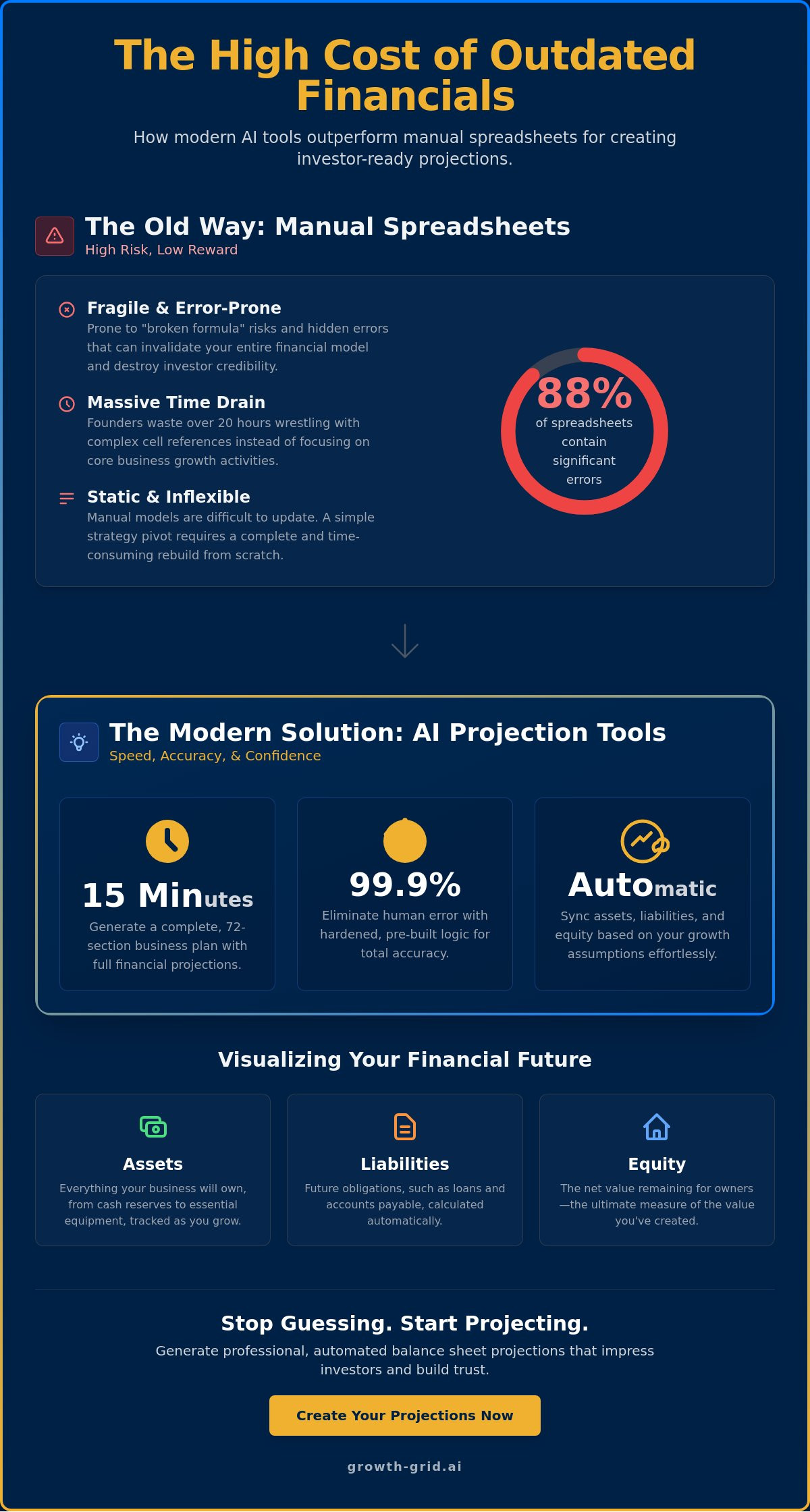
- Understand how modern software predicts your future financial health by automatically syncing assets, liabilities, and equity based on growth assumptions.
- Eliminate the 88% error rate found in manual spreadsheets and reclaim 20+ hours of founder time with a professional balance sheet projection tool.
- Compare templates, traditional software, and AI to identify the most cost-effective and fastest solution for creating investor-ready documents.
- Master scenario modeling to test "what if" situations and ensure your financial strategy remains robust under any market conditions.
- Learn the 15-minute process to generate a complete, 72-section business plan with full financial projections without hiring expensive consultants.
What is a Balance Sheet Projection Tool?
Stop guessing where your business will be in twelve months. A professional balance sheet projection tool is a strategic engine that predicts your company's future financial position with surgical precision. It's a modern software solution that moves beyond static data entry. By using your specific growth assumptions, the tool automatically calculates your Assets, Liabilities, and Equity for the months and years ahead. This isn't just about keeping records; it's about visualizing your roadmap to solvency and stability. You can model how hiring more staff or purchasing new equipment impacts your bottom line instantly.
Traditional methods rely on manual Excel sheets, which are a legacy trap. These spreadsheets are prone to "broken formula" risks that can invalidate your entire financial model. One accidental deletion in a hidden cell can lead to a catastrophic error in your pitch deck. A dedicated projection tool eliminates this friction by using hardened, pre-built logic. It's now a standard requirement for founders in 2026 who need to secure SBA loans or attract venture capital. Investors expect to see a dynamic model, not a fragile document that breaks under minor scrutiny. Professionalism starts with the tools you choose to represent your vision.
The Three Pillars of Financial Projections
Your projected balance sheet rests on three critical components. Understanding these helps you see how your business scales over time and ensures you're prepared for future growth spurts.
- Assets: This includes everything your business will own. Think about your future cash reserves, inventory levels, and essential equipment. The tool tracks how these grow as you reinvest profits into the company.
- Liabilities: These are your future obligations. The system calculates what you'll owe, such as long-term loans, credit lines, and accounts payable to vendors.
- Equity: This is the net value remaining for the owners. It represents the true health of your investment after all debts are settled. It's the ultimate measure of the value you've created.
Why Investors Demand Projected Balance Sheets
Investors don't just care about your current bank balance. They want to see your long-term solvency and financial health. A projected balance sheet proves you have a plan to use their capital effectively. It shows exactly how much of their investment will go toward tangible assets versus operational debt. This level of transparency builds immediate trust during the due diligence process and sets you apart from less prepared competitors.
These projections also provide a vital benchmark for your cash flow analysis. Many sophisticated analysts use the pro-forma balance sheet method to verify that your cash assumptions align with your projected growth. By showing how your assets and liabilities shift month-over-month, you demonstrate a level of professional oversight that manual templates simply can't match. It transforms your financial data from a static report into a compelling narrative of future success that resonates with stakeholders.
The Hidden Costs of Manual Spreadsheet Projections
Excel feels free until you value your time. Many founders spend 20 or more hours wrestling with cell references and circular logic just to produce a basic forecast. This isn't just administrative work. It's a massive drain on your most valuable resource. Every hour you spend debugging a spreadsheet is an hour you aren't closing sales, refining your product, or leading your team. When you calculate your effective hourly rate, that "free" template suddenly becomes one of your business's largest expenses.
The risks go beyond lost time. Research consistently shows that 88% of spreadsheets contain significant errors. In a financial context, a single misplaced decimal or a broken link can invalidate your entire pitch. Investors have a keen eye for these inconsistencies. If your assets don't perfectly align with your liabilities and equity, your credibility vanishes instantly. Using a dedicated balance sheet projection tool ensures your math is hardened and your logic is sound. It moves you away from the fragile "DIY" model and toward a professional standard that investors trust.
The Opportunity Cost of Excel
Think about the speed of your growth. If manual modeling delays your funding round by just two weeks, what is that worth in lost momentum? While you're fixing formulas, your competitors are capturing market share. Static data is another silent killer. A manual sheet won't update when your strategy shifts. If you decide to pivot or change your pricing, you have to rebuild the model from scratch. This friction often leads founders to make decisions based on outdated information because the cost of updating the sheet is too high. You can avoid this by using automated financial planning to keep your data live and actionable.
Professional fees add another layer of cost. Many startups pay thousands of dollars to consultants or CPAs for basic document drafting. While expert advice is valuable for high-level strategy, you shouldn't have to pay a premium for simple arithmetic. Modern tools handle the heavy lifting of Pro Forma Financial Statements, allowing you to save your consulting budget for complex tax planning or legal oversight.
Common Errors in DIY Financial Models
Even experienced founders fall into common traps when building their own models. These errors are often subtle but have a compounding effect on your projections.
- Mismatched Depreciation: Failing to align your depreciation schedules with actual asset values leads to an inflated or deflated bottom line.
- Accounts Receivable Lag: Many DIY models assume cash arrives the moment a sale is made. Real-world lag times can create a cash crunch that your spreadsheet fails to predict.
- The Balancing Equation: It's surprisingly easy to break the fundamental accounting equation (Assets = Liabilities + Equity) when manually adding rows or columns.
A professional balance sheet projection tool automates these connections. It ensures that every change you make flows correctly through the entire document. You get the accuracy of a CPA at a fraction of the cost and time.
Choosing the Right Tool: Templates vs. Software vs. AI
The financial modeling world is splitting into three distinct lanes. You're likely currently stuck in the slowest one. As the business plan software market evolves, the focus has shifted from manual control to automated accuracy. Your choice of a balance sheet projection tool should reflect your business's maturity and your personal technical comfort. Speed is now the primary differentiator in 2026. If you're still building from scratch, you're losing momentum.
Excel Templates (The Legacy Method)
Excel templates represent the traditional approach. They're best for finance professionals who want to touch every single cell in a worksheet. However, the drawbacks are significant. You face a high risk of error and a steep learning curve. There's zero automation. Building a reliable model this way typically takes 10 to 30 hours of focused work. Even when following the Federal Reserve's guide to balance sheet projections, the manual effort required is immense. It's a high-friction approach that slows down your funding process. Most founders find this method more frustrating than helpful.
Financial Planning Software (The Mid-Tier)
Mid-tier financial planning software is better for established companies. These platforms are best for businesses with existing accounting data to sync. The main drawbacks are the expensive monthly subscriptions and the time required for complex data integration. It's a moderate speed option, usually taking 2 to 5 hours to set up properly. It's powerful, but it's often more than a pre-revenue startup actually needs. You end up paying for enterprise features that don't help you get through your next pitch meeting.
AI-Powered Generation (The Modern Standard)
AI-powered generation is the modern standard. It's the best fit for founders who need a startup business plan immediately. You get instant generation and investor-ready formatting. The best part? There's zero math required on your end. You can go from a blank page to a full financial model in under 15 minutes. This isn't just about speed. It's about removing the technical barriers that keep great ideas from getting funded. You answer simple questions about your vision, and the AI handles the complex accounting logic. It's efficient, professional, and built for the pace of modern business.
Stop settling for slow processes. If you're a founder, your time is better spent on growth than on debugging rows. Choose the tool that scales with your ambition, not your patience for spreadsheets.
5 Essential Features of a Professional Projection Tool
Precision is the baseline. In 2026, a professional balance sheet projection tool must do more than just add up columns. It needs to act as a strategic partner that validates your business model. If your software doesn't automatically link every entry to your cash flow and profit and loss statements, you're building a house of cards. High-quality tools focus on five specific pillars to ensure your data stands up to the toughest due diligence.
- Automated Balancing: The software must use hardened logic to ensure Assets always equal Liabilities plus Equity.
- Scenario Modeling: You need to test "what if" situations, such as a 20% increase in sales or a sudden spike in churn, with a single click.
- Professional Export: Your output should be ready for the boardroom. Look for clean PDF and DOC formats that require zero additional formatting.
- Full Statement Integration: Your balance sheet shouldn't exist in a vacuum. It must sync instantly with your P&L and Cash Flow statements.
- User-Friendly Interface: You don't have time for a week-long training course. The tool should be intuitive enough for any founder to navigate.
Why Automated Balancing is Non-Negotiable
Nothing kills a pitch faster than a balance sheet that's off by a single dollar. It signals a lack of professional oversight. Modern AI tools use logic gates to prevent these mathematical impossibilities before they happen. This automation removes the stress of manual reconciliation. When your documents are perfectly balanced, you project a level of competence that boosts investor confidence. It proves that your financial foundation is solid and your data is reliable.
Narrative Integration: Data Meets Strategy
Numbers alone don't tell the whole story. A high-end tool helps you explain the "why" behind the figures. This is essential when drafting a business plan that actually converts. Your financial story must match your market analysis. If you're projecting a massive increase in inventory assets, your narrative should explain the supply chain strategy supporting it. This integration ensures that your strategy and your math are speaking the same language. It transforms a dry report into a compelling vision for growth.
Stop struggling with disconnected data and start building a cohesive financial strategy. You can generate your financials now and have investor-ready documents in hand today. Don't let technical friction slow down your progress.
Generate Your Financial Projections with GrowthGrid AI
Stop wasting weeks on broken spreadsheets. GrowthGrid AI is the definitive balance sheet projection tool for modern founders who value their time. We've helped over 50,000 entrepreneurs move from concept to investor-ready documents in record time. Our engine doesn't just give you a simple table of numbers. It generates a comprehensive 72-section plan that covers every aspect of your strategy, marketing, and operations. You get professional results at a fraction of the cost of hiring a CPA for basic document drafting.
Precision is our standard. By automating the most tedious parts of financial modeling, we allow you to focus on what actually matters: growing your company. Our platform removes the "spreadsheet hell" that stalls so many startups. Instead of debugging circular references, you'll be preparing for your next pitch with total confidence in your data. The math is hardened, the logic is sound, and the output is guaranteed to impress.
The GrowthGrid Advantage
We built this system to solve the friction of legacy business planning. Our AI handles all the complex math, ensuring that your assets, liabilities, and equity balance perfectly every time. You don't need to worry about mismatched totals or outdated formulas. You receive documents formatted to professional standards, ready for any boardroom or bank loan application. Beyond financials, we provide total business support through our AI Legal and HR document generators. It's a complete ecosystem designed to remove administrative friction from your daily workflow.
Ready to Launch Your Business?
Starting your first projection is simple and takes less than 15 minutes. You don't need a finance degree or a background in accounting to get started. Just follow these steps:
- Answer Questions: Respond to a series of targeted prompts about your business vision and growth goals.
- Generate: Let the AI engine calculate your full 3-year or 5-year financials instantly.
- Download: Export your completed 72-section ai business plan in PDF or Word format.
You can download your documents immediately and start sharing them with partners or investors. This is the fastest way to move from "idea" to "execution" without the typical overhead. Join the modern era of business planning today. Build your future with a tool that works as hard as you do. Your vision deserves a professional foundation, and we're here to provide it in minutes.
Take Control of Your Financial Future
You've seen the hidden costs of sticking with legacy spreadsheets. Spending 20+ hours on broken formulas isn't just inefficient; it's a risk to your business's credibility. By choosing a modern balance sheet projection tool, you ensure that your assets, liabilities, and equity stay in perfect alignment. This isn't just about the math. It's about presenting a professional, investor-ready vision that stands up to scrutiny. Don't let administrative friction hold your startup back from its next growth milestone.
Ready to stop the manual struggle? Join the 50,000+ founders who trust our engine to deliver 72-section comprehensive plans in minutes. You can download your financials in PDF or DOC format immediately and start pitching today. Generate Your Investor-Ready Business Plan in 15 Minutes and get back to building your company. Your vision deserves a foundation that's as ambitious as your goals. Let's get to work.
Frequently Asked Questions
Can I use an AI balance sheet projection tool for an SBA loan?
Yes. SBA lenders require professional pro-forma financials as part of your application package. Using an AI tool ensures your documents meet standard banking requirements and are formatted correctly. It provides the three-year or five-year outlook that lenders expect to see. This speed helps you submit your application faster than waiting for a manual draft from a consultant.
What is the difference between a balance sheet and a cash flow statement?
A balance sheet shows what your business owns and owes at a specific point in time. It focuses on your assets, liabilities, and equity. A cash flow statement tracks the actual movement of cash in and out of your business over a period. Think of the balance sheet as a snapshot of your financial health and the cash flow statement as your activity log.
Do I need to be an accountant to use financial projection software?
No. Modern tools are built for founders who don't have a background in finance. You simply answer intuitive questions about your business model and growth goals. The software handles the complex accounting logic and balancing equations in the background. It removes the technical friction and ensures your math is professional and accurate without requiring a CPA.
How far into the future should my balance sheet projections go?
Most investors and banks expect to see three to five years of projections. Your first year should be detailed on a monthly basis to show immediate operational planning. Years two through five are usually summarized annually. This timeframe demonstrates long-term viability while keeping your immediate roadmap clear. It shows you have a realistic plan for scaling your assets and managing debt.
Is it better to use a free template or a paid projection tool?
Paid tools provide automation and accuracy that free templates cannot match. Static templates are prone to significant errors and require hours of manual data entry. A professional balance sheet projection tool offers dynamic updates and investor-ready formatting. It saves you dozens of hours of labor. The small investment is highly cost-effective compared to the time lost on manual troubleshooting.
What happens if my actual financial results don't match my projections?
Projections are strategic roadmaps, not rigid guarantees. Investors expect some variance between your forecast and your actual results. The real value lies in showing your underlying logic and assumptions. If your results differ, you simply update your model to reflect the new data. This flexibility allows you to pivot quickly and maintain a realistic path toward your long-term growth targets.
Can I export my balance sheet projections to Excel later?
Yes. Most professional systems allow you to download your completed documents in PDF or DOC formats for immediate use. Many platforms also offer Excel exports for founders who want to perform additional custom analysis. This gives you the speed of AI generation with the flexibility of traditional software. You get the best of both worlds: instant results and total control over your data.