

Investors don't actually fund ideas; they fund the people who can execute them. You've probably felt the pressure of staring at a blank page, wondering how to make your startup look like a venture-backed powerhouse. It's frustrating to spend hours tweaking bios that still read like dry resumes or wrestling with org charts that never look quite right. You know your vision is solid. However, if the management team section of business plan doesn't scream execution capability, your pitch will likely stall before the first meeting.
You don't need to hire a $5,000 consultant to look professional. This guide shows you how to draft a high-impact management section that proves you're ready for the 2026 market. You'll learn how to leverage the $5.7 billion fractional executive market to fill gaps, align your compensation with 2026 benchmarks like the $153,000 seed-stage CEO average, and satisfy new SBA citizenship requirements. We're moving past the "old way" of manual drafting. Instead, you'll see how to use AI to generate a polished, investor-ready team structure in minutes so you can stop stressing and start scaling.
Key Takeaways
- Understand why investors prioritize execution over ideas and how to prove your team has the "human capital" to succeed.
- Identify the "Core Four" leadership roles required for your model and learn to draft achievement-oriented bios that beat boring resumes.
- Turn team gaps into a strategic "Honesty Advantage" by effectively listing TBD roles and high-value fractional experts.
- Discover how to structure the management team section of business plan to include modern advisory boards and the rising fractional C-suite.
- Save over 40 hours of manual writing by using AI to instantly extract your team's strengths and generate professional bios.
Why the Management Team Section is the Heart of Your Business Plan
The management team section of business plan isn't just a list of names; it's the engine room of your entire pitch. While your product describes what you're building, this section defines who is actually going to build it. At its core, this part of your document outlines the leadership hierarchy and the specific skills that will drive the business toward its milestones. According to this Business Plan Overview, a professional plan must demonstrate that the team has the capacity to carry out the proposed strategy. Without it, your financial projections are just numbers on a page with no one to hit them.
Investors usually fund execution capability over raw ideas. They look for "human capital," which is the collective experience and talent of your leadership. This section bridges the "Execution Gap," the distance between your big vision and your realistic ability to deliver results. It's also where you distinguish between management and organization. Management is about the specific leaders currently at the helm; organization is your broader talent strategy for scaling. You need both to prove that your business is a stable vehicle for capital.
What Investors Are Really Looking For
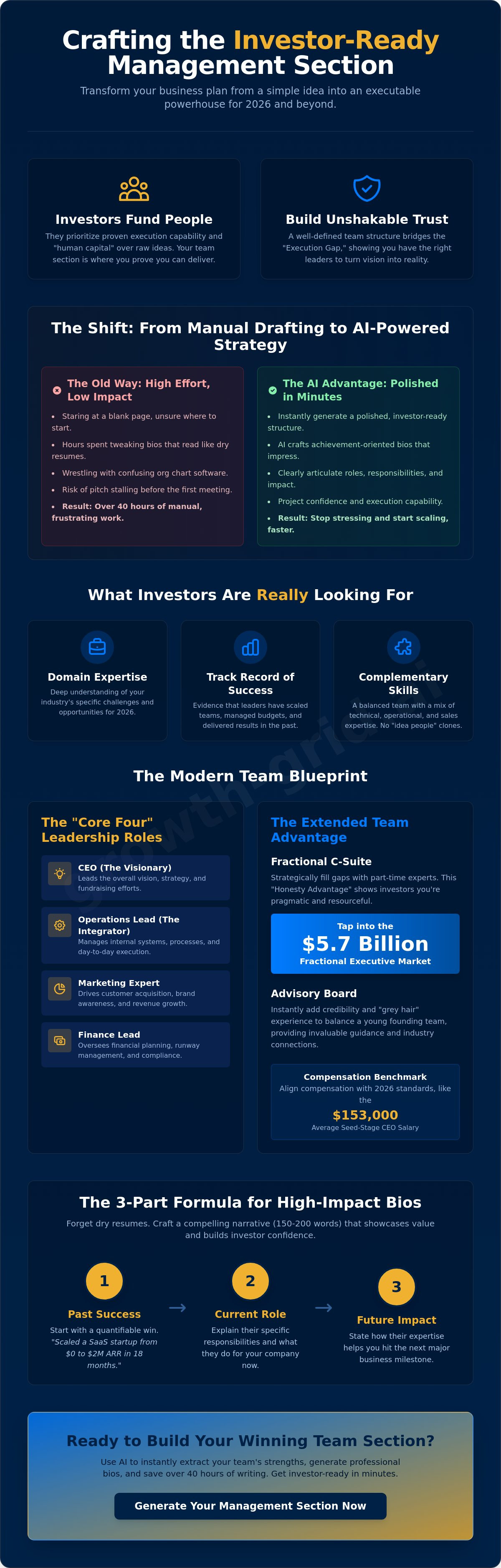
Domain expertise is non-negotiable. Investors need to see that your team understands the specific industry challenges you'll face in 2026. They look for a track record of success, such as evidence that your leaders have managed similar budgets or scaled teams in the past. Complementary skills are equally vital. A team of three identical "idea people" is a red flag. You want a mix of technical, operational, and sales expertise. If your CEO understands the vision but lacks a technical lead, you must address how you'll fill that void to maintain confidence.
The Psychology of the All-Star Lineup
You don't need a staff of fifty to look professional. Projecting confidence is about showing you have the right people in the right seats, even if some of those seats are currently filled by fractional experts. The global market for fractional executives has surpassed $5.7 billion, and savvy founders use this to their advantage. It's helpful to define the founder as either the "Visionary" or the "Integrator." One sets the course, while the other manages the daily systems. Transparency about your team gaps actually builds trust with VCs. Admitting you need a CFO shows you're a pragmatic leader who knows exactly what's required to reach the next level of growth.
How to Write Your Management Section: A Step-by-Step Framework
Stop treating your team section as an afterthought. To win over investors in 2026, you need a structured approach that emphasizes execution over mere titles. Start by identifying your "Core Four" roles. Every scalable business needs a CEO to lead the vision, an Operations lead to manage systems, a Marketing expert to drive growth, and a Finance lead to protect the runway. Even if you're currently wearing multiple hats, your management team section of business plan must show that you understand these distinct functions and have a plan to fill them as you scale.
Next, define clear KPIs for every leadership position. Investors want to see that your COO isn't just "managing stuff" but is responsible for specific metrics like reducing churn or improving fulfillment speed. Integrating an Advisory Board is your final step for instant credibility. These external experts provide the "grey hair" experience that balances a young, energetic founding team. For a standard template on these requirements, check the SBA Guide to Business Plans, which outlines the traditional expectations for organizational management.
Drafting High-Impact Professional Bios
Forget the dry, chronological resume. Use a three-part formula: Past success, current role, and future impact. Start with a quantifiable win, like "Scaled a SaaS startup from $0 to $2M ARR in 18 months." Then, explain exactly what they do for your company now. Finish by stating how their expertise helps you hit the next major milestone. Keep these bios between 150 and 200 words. Skip the hobbies; investors don't care about your marathon times. They care about your ability to return their capital. If you're struggling to find the right words, you can generate professional bios instantly using AI tools designed for busy founders.
Visualising Your Team Hierarchy
A visual Organisational Chart is essential for showing clear lines of authority. It proves you've thought about reporting structures and accountability. Whether you use a flat startup model or a traditional hierarchy, your chart should link directly to your startup business plan milestones. For example, if your goal is to launch a new product in Q3, your chart should show the technical lead responsible for that delivery. Use modern design tools to keep it clean and scannable. A cluttered chart suggests a cluttered mind, which is the last thing an investor wants to see.
Filling the Gaps: What to Do If Your Management Team Is Not Complete
Don't panic if your C-suite is half-empty. Investors actually value self-awareness over a fake "perfect" team. In fact, admitting you need a CFO is often better than pretending you can handle complex tax structures and audit preparation on your own. This is what we call the "Honesty Advantage." When you identify specific vacancies in the management team section of business plan, you demonstrate that you understand exactly what's required to scale. It proves you aren't a "one-man band" with a blind spot, but a strategic leader building a real organization.
Listing "TBD" roles doesn't make you look understaffed if you do it correctly. The key is to connect these future hires directly to your funding request. For example, state clearly that your seed round will fund a Head of Sales once you hit your initial pilot milestones. This shows a direct link between the capital you're asking for and the execution capability you're building. Using established industry frameworks helps you organize these gaps logically so they look like opportunities rather than risks.
The Future Hires Roadmap
Create a simple "Hiring Plan" table within your document. Don't just list names; list trigger points. If you say, "At 1,000 active users, we will hire a Lead Engineer," you show that your hiring is data-driven, not random. This roadmap proves you know which technical or operational skills are missing from your current roster. It transforms a perceived weakness into an operational milestone that investors can track. It also shows you've researched the market, acknowledging that a median CTO salary in 2026 is $250,000, and you've budgeted accordingly.
Mitigating Risk for Investors
Venture capitalists worry about your ability to attract talent in a competitive market. To mitigate this, outline your recruitment strategy and estimated timelines. Show that you have a pipeline of candidates or a partnership with a specialized recruitment firm. You can use business plan software to model the exact cost of these future hires, ensuring your financial projections remain realistic and your runway is protected. Until these gaps are filled, our current leadership team will manage the workload by focusing on core product development and initial customer acquisition. This shows you have a plan for the transition period without burning through cash too early.
Modern Management Structures: Showcasing Advisors and Fractional Roles
The old way of writing a business plan assumed every leader was a full-time, W2 employee. That's no longer the reality for high-growth startups. In 2026, the global market for fractional executives has surpassed $5.7 billion, growing at a steady 14% annually. Smart founders now use this trend to their advantage in the management team section of business plan. By including part-time experts, you show investors that you have senior-level talent without the $293,095 median COO salary overhead. It proves you're running a lean, efficient operation that maximizes every dollar of potential funding.
You also need to distinguish between your Advisory Board and your Board of Directors. A Board of Directors has legal fiduciary duties and governance power. An Advisory Board, however, provides specialized guidance and industry connections without the legal red tape. If you have a high-profile lawyer or an accountant with deep startup experience, include them as external consultants. This demonstrates that your professional network is robust. Geographic diversity is another modern strength. A remote leadership team proves you can source the best talent globally, rather than being limited by a local talent pool.
Leveraging Your Advisory Board
An advisor's reputation creates a "halo effect" that validates your startup's potential. When drafting their bios, focus on their specific industry connections and previous successful exits. Don't just list them as names on a page. Quantify their involvement by mentioning monthly strategy meetings or ad-hoc consulting hours. This tells investors that these heavy hitters are actually active in your success, not just lending their names for a pitch deck. It's a low-cost way to add massive credibility to your leadership hierarchy.
The Fractional Advantage
Hiring a fractional CMO or CTO is often smarter than a full-time hire for an early-stage company. It allows you to access $250,000-level CTO talent for a fraction of the cost. Present these roles as a strategic choice for lean operations. It is projected that over 35% of U.S. businesses will utilize fractional hiring by the end of 2026, so investors are already primed for this model. Ensure your ai business plan reflects these modern cost structures accurately. By showing you can manage a hybrid team, you prove you're ready for the 2026 business landscape.
Generate Your Management Section ✨: The GrowthGrid Advantage
Why spend weeks stressing when you can have it done in minutes? The old way of drafting a management team section of business plan is broken. It usually involves 40+ hours of manual research, bio-writing, and formatting. It's frustrating and slow. Worst of all, manual plans often fail to align your leadership hierarchy with your financial goals. GrowthGrid offers the smart way. Our AI-driven platform extracts your team's hidden strengths by asking the specific questions investors care about. We don't just list titles; we build a narrative of execution capability that proves you're ready for 2026.
GrowthGrid ensures your management section perfectly aligns with your financial projections and market analysis. If your plan claims you'll hit $5M in revenue, our system verifies you have the sales leadership to get there. It takes the guesswork out of the process. You get a polished, professional document that looks like it was written by a top-tier consultant, but without the $5,000 price tag. You'll love your plan or your money back. It's that simple.
From 40 Hours to 8 Minutes
The process is incredibly efficient. You answer a few punchy questions about your core team, and our GPT-4 model structures bios for maximum investor impact. It handles the heavy lifting of drafting a full 72-section plan in under 15 minutes. Whether you are in Tech, Retail, or Manufacturing, the system customizes the team structure to meet industry-specific expectations. It automatically integrates the "Core Four" roles we discussed earlier, ensuring your leadership bios focus on quantifiable wins rather than generic fluff. You get a high-quality result instantly, saving you weeks of tedious work.
Professional Quality, Guaranteed
Security and professionalism are our top priorities. We use bank-level encryption to keep your team's sensitive data secure throughout the entire process. Once your plan is ready, you can download it in professional PDF or DOC formats for easy sharing with stakeholders or VCs. You don't have to worry about formatting org charts or wrestling with layout software. Everything is generated to meet the highest professional standards. Stop wasting time on the "Old Way" and start building your future today.
Build Your Winning Leadership Lineup Today
You've seen how the right leadership structure bridges the execution gap and how modern fractional roles can save you thousands in overhead. Mastering the management team section of business plan is about proving you have the human capital to turn projections into reality. Transparency about your team gaps doesn't show weakness; it shows a strategic roadmap for growth that investors trust. By leveraging advisory boards and achievement-oriented bios, you position your startup as a professional, low-risk vehicle for capital.
Why spend 40 hours wrestling with formatting when you can have a professional, 72-section comprehensive plan ready in minutes? Join thousands of founders worldwide who have already ditched the old, frustrating way for a faster, smarter solution. We offer a 100% Satisfaction Guarantee because we're confident your team will look like the all-star lineup VCs crave. It's time to stop stressing about the paperwork and start focusing on your vision.
Create your professional business plan in 8 minutes ✨
Frequently Asked Questions
What is the management team section of a business plan?
This section defines your leadership structure and the specific people responsible for executing your strategy. It highlights key roles like the CEO and COO while detailing their past successes and future responsibilities. It's essentially a proof of execution capability that shows investors your team has the human capital to hit your projected milestones.
How long should the management team section be?
Aim for two to three pages within a standard 40-page plan. You should dedicate approximately 150 to 200 words per key executive bio to keep the document punchy and scannable. This length provides enough detail to showcase industry expertise without overwhelming the reader with unnecessary background information.
What if I am a solo founder with no management team yet?
Focus on your own background and clearly outline the specific roles you plan to hire next. Use trigger points to show operational readiness, such as hiring a Lead Engineer once you reach 1,000 users. This proves you have a strategic hiring roadmap and understand exactly which skills are currently missing from your roster.
Should I include an organisational chart in my business plan?
Yes, a visual org chart is essential for showing clear lines of authority and accountability. It helps investors quickly understand the management team section of business plan by illustrating who is responsible for specific KPIs. A clean chart suggests an organized mind and a business that's ready to scale efficiently.
What is the difference between an advisor and a manager in a business plan?
Managers handle daily operations and have specific performance metrics, while advisors provide strategic guidance and industry connections. Advisors don't usually have full-time salaries or fiduciary duties. Including both in your plan shows a healthy balance between youthful energy and seasoned "grey hair" experience.
How do I write a bio for a manager if they haven’t started yet?
Create a detailed profile of the ideal candidate and list the specific qualifications you're seeking. Connect this vacancy directly to your funding request. For instance, state that your seed round will fund a Head of Sales with at least five years of experience in your specific industry niche.
Can I use AI to write my management team section?
Yes, using AI is the smart way to generate professional bios and structures in under 15 minutes. Modern tools use GPT-4 models to extract your team's hidden strengths and align them with your financial projections. It's a massive time-saver that eliminates the stress of manual drafting and formatting.
Do I need to include resumes in the management section?
No, you should keep full resumes in the appendix and use achievement-oriented bios in the main management team section of business plan. Investors want to see quantifiable wins and current responsibilities at a glance. Full resumes often contain too much irrelevant data that slows down the decision-making process.