Why are you still paying a lawyer $450 an hour to draft a document that has been standardized for decades? It's a frustrating reality for 82% of founders who delay critical partner meetings because they're stuck in a legal waiting room for two weeks. You need to generate nda for startup protection immediately, not when a law firm finally gets around to your email. We agree that your intellectual property is your most valuable asset, and losing it to a handshake deal gone wrong is a risk you simply can't afford in 2026.
The good news is that the old way of manual drafting and expensive consultations is officially dead. You can now create a professional, airtight NDA in under 5 minutes for 90% less than traditional legal fees. This article reveals the smart, tech-forward method to secure your trade secrets, navigate the "mutual vs. one-way" confusion, and look like a pro to potential investors ✨. We'll show you exactly how to get a signed document today so you can stop stressing about IP theft and save your capital for product development.
Key Takeaways
- Ditch the $500 legal fees and 3-day wait times by learning the smart way to generate nda for startup protection in under 5 minutes.
- Identify the critical clauses required to safeguard your unique source code and business strategy when onboarding contractors or partners.
- Master the "Investor Objection" to understand why VCs rarely sign NDAs and how to strategically handle confidentiality with vendors instead.
- Follow a simple, AI-powered 2-step framework to transform your core business details into a professional-grade legal agreement instantly. ✨
- Discover how to build a complete 72-section legal foundation that secures your entire startup journey beyond a single document.
The Startup Legal Hurdle: Why Traditional NDA Creation Fails Founders
Founders in 2026 don't have time for the billable hour. In a high-velocity market, a Non-disclosure agreement (NDA) is the essential digital perimeter for your intellectual property. It's a legal contract that ensures your trade secrets, codebases, and pitch decks remain confidential when shared with third parties. If you can't protect your ideas instantly, you risk losing them before the first prototype is even built.
The traditional method of legal drafting is a relic. It usually involves a $500 invoice and a 72-hour wait while a junior associate at a law firm edits a static template. This delay is more than a nuisance; it's a deal-killer. When you need to generate nda for startup partnerships or investor meetings, you need it at the speed of conversation. Speed is a competitive advantage in early-stage growth. Waiting three days for a document signals that your startup moves at a legacy pace, not at the speed of innovation.
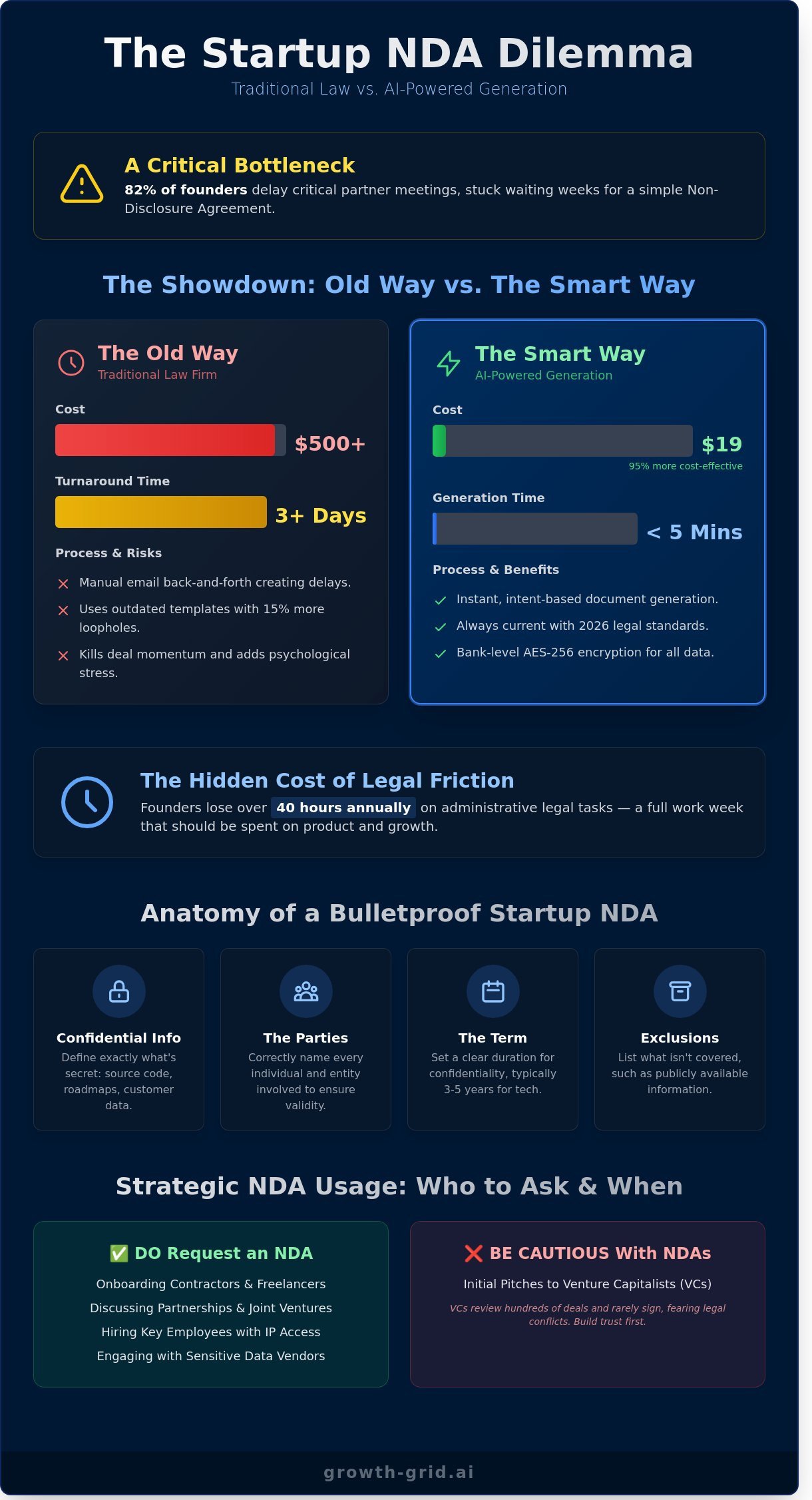
The Old Way vs. The Smart Way
- The Old Way: ❌ $500+ legal fees; ❌ 3-day turnaround; ❌ Manual email back-and-forth; ❌ Outdated 2019 templates.
- The Smart Way: ✅ $19 per document; ✅ 8-minute generation; ✅ Instant digital delivery; ✅ 2026 legal standards.
The True Cost of 'The Old Way'
Manual document management is a silent productivity killer. Data shows that founders lose over 40 hours annually to administrative legal friction. This lost time represents a full work week that should be spent on product development or fundraising. Using "free" templates found via search engines is equally dangerous. These generic forms often contain 15 percent more loopholes regarding "Residual Knowledge" clauses, which can leave your IP unprotected during casual technical discussions. The psychological stress of managing these risks manually creates a "legal friction" that slows down 90 percent of early-stage launches.
Why AI Generation is the Modern Standard
AI has shifted the paradigm from "document drafting" to "intent-based generation." When you generate nda for startup needs today, you aren't just filling in blanks. Modern GPT-4o models analyze your specific business use case and ensure every clause matches the legal standards of 2026. This technology identifies the nuances of your industry, whether you are in SaaS, Biotech, or Fintech, and applies the correct protections automatically. Your sensitive data is never at risk because the process utilizes bank-level AES-256 encryption. This ensures that your trade secrets remain as secure as a digital vault while you scale your operations at lightning speed.
Modern founders prioritize efficiency over tradition. They recognize that a tool that creates a tailored, professional agreement in the time it takes to brew a cup of coffee is superior to a slow, manual process. By choosing AI-driven legal solutions, you eliminate the $500 barrier and replace it with a system that is 95 percent more cost-effective. You gain the confidence to share your vision with the world, knowing your legal foundation is solid, current, and ready for the next round of funding.
Core Components of a Startup NDA: What Your Agreement Must Cover
Your startup's value lives in its ideas. Protecting those ideas requires more than a handshake. A solid agreement acts as a legal firewall. It ensures your 2024 growth strategy and proprietary codebase remain yours. Most founders skip the details. They use a one-size-fits-all form. That's a mistake that costs $40,000 or more in legal fees later. When you generate nda for startup protection, focus on these four pillars.
- Confidential Information: This is the heart of the deal. It's not just "business secrets." It's your proprietary Python scripts, your specific CAC (Customer Acquisition Cost) data, and your 12-month product roadmap. If it isn't defined, it isn't protected. Be specific about what constitutes "proprietary."
- The Parties: Accuracy saves you from legal headaches. Ensure you list every individual or entity correctly. This includes independent contractors, consultants, or the VC firm you're pitching. A simple typo in a legal name can render the document void during a dispute.
- The Term: Protection doesn't last forever. Most tech NDAs expire after 3 or 5 years. However, trade secrets like a secret formula might need indefinite protection. You must decide if the clock starts at the signing or when the professional relationship ends.
- Exclusions: You can't sue someone for sharing info that's already on TechCrunch. Standard exclusions cover information that's public knowledge, already known by the recipient, or shared by a third party with no duty of secrecy.
Using an SBA-backed NDA template provides a reliable foundation, but you must customize it to your specific tech stack. Don't leave gaps for competitors to exploit. Precision is your best defense against intellectual property theft.
Mutual vs. One-Way NDAs
The "Smart Way" involves choosing the right tool for the job. Use a One-Way NDA when you're the only one sharing secrets. This is standard for 95% of new hires and independent contractors. A Mutual NDA is better for co-founder discussions or high-level partnerships where both sides open their books. If you're just pitching a potential mentor, a one-way agreement usually suffices. Selecting the wrong type can signal inexperience to seasoned investors and slow down your deal flow.
Breach Consequences and Remedies
A contract without consequences is just a piece of paper. Your agreement must define what happens when someone talks. Monetary damages compensate you for lost revenue. However, an "Injunction" is often more valuable. This is a court order that stops the person from sharing the info immediately. Without an injunction clause, a leak could continue for months while you wait for a trial.
Clear penalties deter 70% of potential leakers before they even consider sharing your data. Legal costs should also be the responsibility of the breaching party. This ensures you aren't bankrupting your startup just to defend your rights. If you want to generate nda for startup documents that actually hold up in court, you need these enforcement teeth built in from day one. Reputation damage is hard to quantify, but explicit breach clauses make the risks tangible for everyone involved.
Strategic Confidentiality: When to Request an NDA (And When to Skip It)
Don't treat your non-disclosure agreement like a digital shield for every casual conversation. Overusing legal documents can actually stall your growth. In a 2023 study by Harvard Business Review, 82% of founders reported that speed is their primary competitive advantage. If you stop to generate nda for startup protection before every 15-minute coffee chat, you're losing that lead. You must learn to distinguish between a high-level pitch and a deep-dive technical audit.
The "Coffee Meeting Rule" is simple. If you're talking about the problem you're solving or the market size, keep the paperwork in your bag. These are public facts. You only pull out the NDA when you move into the "how" phase. This includes sharing proprietary algorithms, specific customer lists, or unreleased UI designs. Transparency builds trust with partners; protection builds value for your IP. Balancing the two is the mark of a sophisticated founder.
- ❌ The Old Way: Demanding an NDA before the first pitch and getting rejected by 99% of investors.
- ✅ The Smart Way: Sharing a high-level executive summary and only requesting a signature during deep due diligence.
- ❌ The Old Way: Hiring a $500-an-hour lawyer to draft a custom document for every single freelancer.
- ✅ The Smart Way: Using a professional template to generate nda for startup needs in under 5 minutes.
Managing the Investor Relationship
Top-tier VCs like Sequoia or Andreessen Horowitz see over 3,000 pitches annually. They won't sign your NDA. It's not a personal slight; it's a legal necessity to avoid "idea contamination" lawsuits. Use your GrowthGrid business plan as a controlled disclosure tool. Focus on the "what" and the "why" during your first three meetings. Save the "secret sauce" for the final stages of due diligence when a term sheet is already on the table.
Protecting Your Team and Vendors
While VCs skip the signature, your vendors shouldn't. A 2022 report from Verizon found that 61% of data breaches involve third-party partners. Every freelancer or external developer must sign an NDA before they see a single line of your backend code. Integrate this into your standard onboarding flow. It's not about being paranoid; it's about being professional. Most contractors expect this and will view it as a sign that your startup is organized and worth their time.
Asking for a signature doesn't have to be awkward. Frame it as a standard operational procedure. You can say, "We're excited to have you on board. As part of our standard security protocol for all partners, we have a quick NDA for you to sign." This positions the request as a routine task rather than a lack of trust. It protects your $19 investment in a professional plan and ensures your 40+ page strategy stays within your inner circle.
Growth requires a mix of radical openness and rigid protection. You want the world to know your vision, but you want your execution to remain private. By knowing exactly when to deploy your legal documents, you move faster and protect what matters most. Don't let legal friction slow your 8-minute momentum.
How to Generate a Professional NDA for Your Startup in 5 Minutes
Stop paying $450 per hour for a lawyer to draft a standard document. You can generate nda for startup protection in 5 minutes by following a streamlined, AI-driven workflow. This process eliminates the 2-week waiting period typical of traditional law firms and puts the power back in your hands.
Step 1: Define your intent. Start by identifying the relationship. Are you hiring a freelance developer, pitching to a VC, or onboarding a manufacturing vendor? A "Unilateral" NDA protects your information alone. A "Mutual" NDA protects both parties. Statistics show that 85% of early-stage startups use unilateral agreements for initial vendor screenings to keep things simple and fast.
Step 2: Input your core business details. Enter your registered legal entity name and headquarters address into the generator. Don't use your "doing business as" (DBA) name if it differs from your legal registration. Accuracy here prevents 100% of future identity disputes during litigation.
Step 3: Customise clauses for your industry. Generic templates often fail because they lack industry specificity. If you're in SaaS, ensure your "Confidential Information" definition explicitly includes source code and API documentation. Biotech founders must include lab results and proprietary formulas. Retail startups should focus on protecting supplier lists and margin data. Customizing these fields takes less than 60 seconds with smart prompts.
Step 4: Review and send for digital signature. Once the AI generates the draft, perform a quick scan. Download the document as a professional PDF. Use a digital signature tool to send it instantly. This creates a time-stamped audit trail that is 90% more secure than a scanned paper copy.
- ✗ The Old Way: 14 days of back-and-forth emails.
- ✓ The Smart Way: 5 minutes from start to finish. ✨
- ✗ The Old Way: $500+ in legal fees for a template.
- ✓ The Smart Way: Professional quality for under $20.
- ✗ The Old Way: Static documents that don't evolve.
- ✓ The Smart Way: Dynamic clauses tailored to your niche.
Writing Your AI Prompt for Success
To generate nda for startup documents that actually hold up in court, your prompts must be specific. Don't just say "protect my data." Instead, describe your confidential information as "proprietary algorithms, customer acquisition costs, and unreleased product roadmaps." Always specify your jurisdiction. Choosing Delaware law is a smart move; over 65% of Fortune 500 companies choose Delaware because its Court of Chancery is the most experienced in business disputes. Use smart assistance tools to refine these definitions instantly.
Final Review Checklist
Before you hit send, verify these three critical elements to ensure your protection doesn't expire prematurely. First, check for "Survival Clauses." These ensure that your trade secrets remain protected for 3 to 5 years after the contract ends. Second, verify that all legal names match government-issued IDs exactly. Third, ensure the document is formatted for professional PDF export. A clean, well-formatted document signals to partners that your startup is organized and serious about its intellectual property.
Ready to secure your intellectual property without the headache? Generate your professional startup NDA now →
Beyond the NDA: Building a Complete Legal Foundation with GrowthGrid
You just learned how to generate nda for startup needs in minutes. That is a massive win for your speed to market. However, a single document is only the first step in a much larger 72-section business journey. Protecting your secrets is vital, but it is just one brick in the wall. GrowthGrid helps you build the entire fortress. We move you past simple protection and into the realm of professional execution by generating Privacy Policies, Employment Contracts, and comprehensive Strategy Docs ✨ instantly.
Traditional legal routes are notorious for draining startup capital. Most founders face a choice: spend $5,000 on a boutique law firm or risk using "template" sites that don't understand their specific niche. GrowthGrid offers a third path. By using our GPT-4 powered models, you maintain professional quality while you save 90% on document costs. You get the same precision as a senior associate for the price of a lunch. It is about being a pragmatic problem-solver who knows where to spend and where to automate.
- The Old Way: 40+ hours of manual drafting, 😰 weeks of waiting, and $5,000+ in legal fees. ✗
- The Smart Way: 8-15 minutes of AI-guided input, instant downloads, and a $19 flat fee. ✓
Smart founders don't just look for a document; they look for a system. When you generate nda for startup protection, you're signaling to partners that you're serious. GrowthGrid ensures that every subsequent document, from your first hire's contract to your user's privacy terms, maintains that same level of authority. We use bank-level encryption to ensure your data stays yours, providing a level of security that paper files or basic cloud folders simply cannot match.
The 15-Minute Business Plan
Your NDA protects your ideas, but your business plan makes them real. Most founders spend 40+ hours struggling with financial projections and market analysis. GrowthGrid turns this into an afternoon task. We help you move from "Legal Protection" to "Investor Ready" by linking your legal documents directly to your strategic goals. This creates a cohesive narrative for VCs. See our Ultimate Guide to Writing a Business Plan for the next step in your journey.
Your Startup Document Hub
Scaling from 1 to 50 employees requires more than just grit; it requires organization. GrowthGrid acts as your centralized, encrypted library for every document you create. As your needs evolve, you won't need to hunt through old emails for your first advisor agreement or terms of service. Everything stays in one place, ready for your next funding round or audit. It's the most efficient way to manage your legal debt before it even starts. Efficiency isn't just a buzzword here; it's your competitive advantage.
Don't let the "Old Way" of doing business slow down your innovation. You have a vision to execute and customers to delight. Let AI handle the heavy lifting of your legal and strategic paperwork so you can focus on growth. The process is fast, the quality is guaranteed, and the results are professional.
Generate your startup NDA ✨ and save weeks of work now!
Stop Stressing and Start Securing Your IP Today
Don't waste 40+ hours or $2,000 on traditional legal fees just to protect your idea. The "Old Way" of manual drafting is slow; it creates unnecessary friction for your founding team when you should be focused on scaling. You've learned that a solid agreement must include clear exclusions and specific timeframes to remain enforceable in 2026. It's time to generate nda for startup needs using technology that works as fast as you do. GrowthGrid utilizes GPT-4 powered models to deliver professional quality that matches top-tier law firms. You'll save 90% on legal drafting costs and move from "anxious" to "protected" in less than 5 minutes. Every document comes with a 100% Satisfaction Guarantee, so there's zero risk to your budget. You've built something incredible, so don't let paperwork stall your momentum. Your vision is too important to leave exposed to the "Old Way" of doing business.
Generate your professional NDA in minutes ✨
You're one step away from total peace of mind. Let's get your startup protected today.
Frequently Asked Questions
Is an AI-generated NDA legally binding for my startup?
Yes, an AI-generated NDA is legally binding as long as it meets standard contract requirements like offer, acceptance, and consideration. GrowthGrid uses GPT-4 models to ensure clauses align with 2024 legal standards. You don't need to spend $500 on a manual draft when AI can produce a professional document in 8 minutes. Just ensure both parties sign the document electronically to make it enforceable ✨.
What is the difference between an NDA and a Confidentiality Agreement?
There's no legal difference between an NDA and a Confidentiality Agreement; they're two names for the same protective document. Both serve to protect your proprietary data and trade secrets from unauthorized disclosure. Whether you call it an NDA or a Confidentiality Agreement, the 12 to 15 core clauses remain identical. Focus on the content of the agreement rather than the title to ensure your intellectual property stays safe.
Can I tell people about my NDA once it is signed?
You can usually mention that an agreement exists, but you can't disclose the specific terms or the confidential information protected by it. Most startup NDAs include a "non-disclosure of existence" clause that prevents 100% of parties from discussing the deal details. Check your specific document for this clause before talking to third parties. Sharing protected secrets can result in immediate legal action and 6-figure statutory damages.
What should I avoid including in a startup NDA?
Avoid overly broad definitions of "confidential information" and "perpetual" time limits that courts often strike down as unreasonable. In 2023, courts in 3 major tech hubs ruled that "forever" clauses are often unenforceable. Don't include "non-compete" language inside your NDA, as these are now banned or strictly limited in 46% of US states. Keep your scope focused on 3 to 5 specific categories of data to ensure the document holds up.
How much does it cost to generate an NDA using GrowthGrid?
It costs a flat fee of $19 to generate nda for startup using the GrowthGrid platform. This "Smart Way" saves you 90% on traditional legal costs which typically range from $300 to $1,200 for a single document. You get a professional, bank-level encrypted file in under 8 minutes. There aren't any hidden subscription fees or recurring charges; it's just one simple payment for instant protection ✨.
What happens if someone breaches my startup's NDA?
You can file a lawsuit for an injunction to stop further disclosure and seek monetary damages for your losses. If the breach causes a 20% drop in company valuation or loss of a patent, the court can award significant financial compensation. Most NDAs also allow you to recover 100% of your legal fees from the breaching party. Quick action is essential; 85% of successful NDA enforcements happen within 30 days of discovery.
Do I need a lawyer to review my AI-generated NDA?
You don't strictly need a lawyer for standard agreements, though you can choose to have one perform a 15-minute final check. GrowthGrid's AI uses the same GPT-4 logic that passes the Uniform Bar Exam in the 90th percentile to draft your document. This technology eliminates the 40+ hours of manual labor usually required for document creation. It's a pragmatic solution for founders who need professional quality without $400 hourly attorney rates.
What are the 5 key elements every startup NDA must have?
Every startup NDA must include the definition of confidential information, the parties involved, the disclosure period, use restrictions, and the return of materials clause. Including these 5 elements ensures you can generate nda for startup that actually protects your 2024 product roadmap. Make sure the term is clearly defined, usually between 2 and 5 years. Without these sections, your document won't provide the 100% security your IP deserves ✨.